

The geopolitical mythology of a unified anti-Western bloc composed of China, Russia, and Iran has long animated strategic debates in Washington, Brussels, and NATO capitals
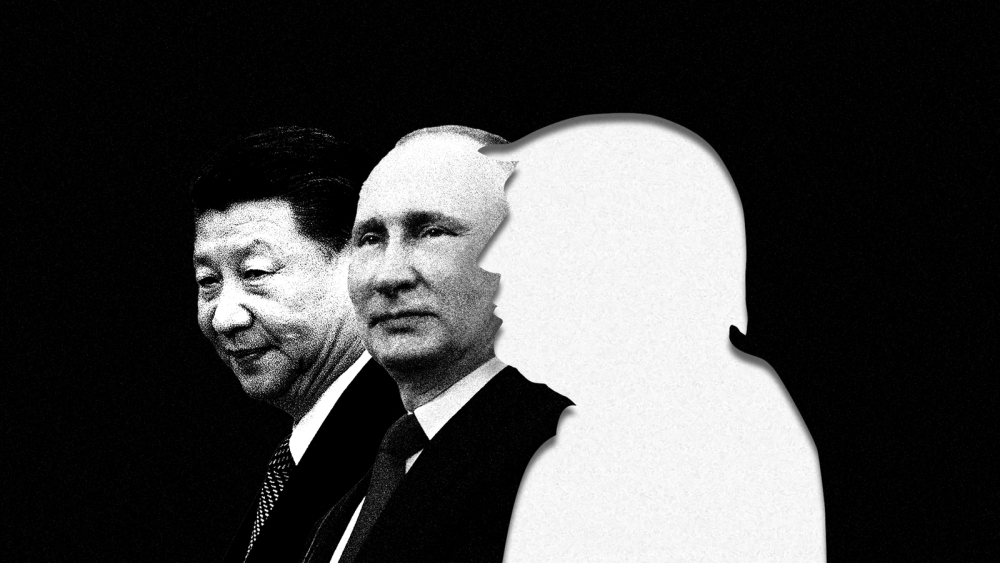
The geopolitical mythology of a unified anti-Western bloc composed of China, Russia, and Iran has long animated strategic debates in Washington, Brussels, and NATO capitals. The image is seductive: three revisionist powers aligned in opposition to the liberal international order, coordinating diplomatically, economically, technologically, and militarily to weaken American primacy and reshape Eurasia. Yet history, geography, economics, and civilizational logic all suggest a different reality. What appears outwardly as an “axis” is, in truth, a fragile arrangement of asymmetrical dependencies, temporary convergences, and concealed rivalries.
President Donald Trump’s recent summit in Beijing with Chinese President Xi Jinping revealed precisely this contradiction. According to the White House readout, Xi explicitly opposed any Iranian attempt to militarize the Strait of Hormuz or impose tolls on maritime transit. Beijing’s own summary notably avoided mentioning Iran altogether, yet significantly did not deny Washington’s characterization. In diplomacy, silence is often more revealing than rhetoric.
That omission was not accidental. It represented a strategic signal.
China’s leadership quietly communicated that its economic imperatives outweigh ideological solidarity with Tehran. The implication reaches far beyond Iran. If Beijing is willing to distance itself from Tehran when Chinese energy security is threatened, then the broader question inevitably emerges: could China eventually recalibrate its relationship with Moscow as well?
The answer lies in understanding the deeper architecture of Eurasian power.
Geography Is Destiny, and Russia’s Greatest Threat Has Never Been the West
For decades, Russian strategic culture has portrayed the West as its existential adversary. NATO expansion, European integration, democratic movements in Eastern Europe, and liberal political norms have dominated Kremlin narratives under Vladimir Putin. Yet this fixation masks a far more profound strategic anxiety: the long-term demographic, economic, and geopolitical imbalance between Russia and China.
Historically, Russian power has always feared encirclement from the Eurasian south and east. The West threatened ideology and prestige; Asia threatens strategic survival.
This anxiety is not theoretical. It is structural.
Russia’s Far East remains sparsely populated, underdeveloped, and economically stagnant, while directly bordering the industrial and demographic colossus of northeastern China. Siberia contains immense energy reserves, minerals, timber, freshwater resources, and Arctic access routes that are increasingly indispensable to Beijing’s long-term economic planning. In purely geo-economic terms, Russia possesses what China requires and lacks the demographic and industrial capacity to fully exploit those resources independently.
The war in Ukraine accelerated this imbalance dramatically.
As Moscow exhausted military manpower, industrial resources, and diplomatic capital attempting to maintain dominance over Kyiv, Beijing quietly consolidated influence across Central Asia and the South Caucasus the very regions Moscow historically considered its strategic backyard.
China’s economic penetration into Eurasia now exceeds Russia’s in nearly every meaningful category.
By 2023, China had overtaken Russia as Central Asia’s largest trading partner. By 2025, China-Central Asia trade surpassed $100 billion, dwarfing Moscow’s regional economic presence. Chinese financing increasingly underwrites infrastructure, logistics corridors, manufacturing hubs, and telecommunications systems throughout Kazakhstan, Uzbekistan, Tajikistan, Kyrgyzstan, Armenia, Azerbaijan, and Georgia.
This transformation represents far more than commerce. It is the gradual displacement of Russian influence through economic absorption rather than military confrontation.
China understands something fundamental about modern power: infrastructure creates dependency more effectively than occupation.
The Middle Corridor: Where Chinese Economics and American Strategy Converge
The most strategically consequential development in Eurasia today may not be occurring on the battlefield in Ukraine, but along the emerging trade architecture known as the Middle Corridor.
This corridor stretches from western China through Central Asia, across the Caspian Sea, through the South Caucasus and Turkey, and onward into Europe. Every kilometer of this route bypasses both Russia and Iran.
That fact alone carries immense geopolitical significance.
For Beijing, the corridor reduces vulnerability to Russian instability, sanctions disruptions, and maritime chokepoints vulnerable to U.S. naval dominance. For Washington, it weakens Moscow’s leverage over Eurasian trade while simultaneously limiting Tehran’s regional relevance.
Rarely in modern geopolitics do Chinese economic logic and American strategic interests align so neatly.
This convergence is deeply unsettling for Moscow.
Russian influence historically depended on controlling Eurasian transit geography. The Kremlin’s strategic identity has always rested upon functioning as the indispensable land bridge between Europe and Asia. But the Middle Corridor threatens to dissolve that monopoly. If Eurasian commerce increasingly flows south of Russia, Moscow risks becoming geopolitically peripheral to the very continent it once dominated.
The implications extend beyond economics. Trade routes shape civilizations. Whoever controls corridors controls influence, standards, dependencies, and political alignments.
China’s investments across the Caspian and South Caucasus are therefore not merely commercial projects. They are instruments of long-term geopolitical restructuring.
Russia’s Silent Fear of China
Official Russian discourse continues to emphasize strategic partnership with Beijing, but beneath the surface lies profound unease.
The asymmetry in the relationship is unmistakable.
China accounts for only a small fraction of its overall trade through commerce with Russia, while Russia has become heavily dependent on Chinese markets, industrial goods, banking access, technology transfers, and consumer imports. Chinese firms now dominate critical sectors supporting Russia’s sanctioned wartime economy, including telecommunications, machinery, electronics, vehicles, and dual-use technologies.
Moscow increasingly resembles a resource appendage to a far larger Chinese-centered economic ecosystem.
More revealing, however, are the strategic calculations occurring inside Russian military institutions themselves.
Leaked Russian war-game documents reportedly reviewed by Western analysts revealed scenarios involving hypothetical Chinese incursions into the Russian Far East, internal destabilization campaigns, infrastructure sabotage, and even discussions involving tactical nuclear responses to Chinese advances. Whether every scenario reflects current operational doctrine is less important than the underlying reality: Russian planners clearly consider China a potential future threat.
And history validates their concern.
Western policymakers often forget that the original Cold War “communist bloc” between the Soviet Union and Maoist China collapsed with astonishing speed. The 1950 Sino-Soviet alliance eventually deteriorated into ideological hostility, border clashes, and strategic rivalry. By the early 1970s, President Richard Nixon and Henry Kissinger exploited that division to fundamentally reshape global geopolitics.
The lesson remains timeless: great powers rarely tolerate permanent equality with neighboring civilizations of comparable scale.
Proximity breeds rivalry.
China’s Strategic Philosophy: Dependency Without Loyalty
Iran now provides the clearest model for understanding Beijing’s broader geopolitical method.
China never viewed Tehran as a genuine ally in the civilizational or ideological sense. Iran functioned instead as a useful pressure point against Western interests and as a discounted energy supplier operating outside Western-controlled financial structures.
But once Iranian brinkmanship threatened the uninterrupted flow of energy through the Strait of Hormuz, a vital artery for Chinese economic stability Beijing recalibrated immediately.
That decision exposes the core principle underlying Chinese grand strategy: relationships are transactional, hierarchical, and conditional.
China does not construct alliances in the Western sense. It constructs dependency networks.
Countries are integrated into Beijing’s orbit through trade asymmetries, infrastructure financing, supply chain integration, debt leverage, technology access, and market dependency. These relationships endure only so long as they continue serving China’s long-term stability and development goals.
Russia increasingly fits this pattern.
Beijing benefits from cheap Russian energy, discounted commodities, strategic distraction against Washington, and access to Arctic routes. But China does not benefit from prolonged Eurasian instability, collapsing European trade systems, uncontrolled escalation, or secondary sanctions that threaten Chinese banking interests.
The moment Russian behavior meaningfully jeopardizes China’s broader economic architecture, Beijing will adjust accordingly.
Not because China is pro-Western.
But because China is fundamentally pro-China.
The Moral and Philosophical Dimension: Power Without Trust Cannot Sustain Order
The deeper philosophical lesson transcends immediate geopolitics.
Civilizations built exclusively upon transactional power eventually encounter internal contradictions. Durable strategic orders require trust, legitimacy, reciprocity, and shared principles, not merely converging grievances against a common adversary.
The emerging Eurasian alignment lacks this cohesion.
Russia seeks imperial restoration. Iran seeks revolutionary resistance. China seeks commercial hegemony and systemic stability. These ambitions overlap tactically but diverge strategically.
This is why the so-called “axis” remains inherently unstable.
The West often misunderstands authoritarian partnerships because it projects ideological coherence onto regimes that are actually motivated by civilizational self-interest. China’s ruling philosophy is not emotional solidarity with anti-Western states; it is strategic patience, economic centrality, and national rejuvenation.
From Beijing’s perspective, Moscow is useful but expendable.
Tehran is useful, but expendable.
Any partner that threatens the uninterrupted expansion of Chinese prosperity ultimately becomes a liability.
Strategic Implications for the United States
For Washington, this reality demands sophistication rather than triumphalism.
The objective should not be romantic illusions of a “reverse Nixon” strategy with Moscow. Russia remains a revisionist power fundamentally hostile to Western institutions and security architecture. But understanding the fragility within Eurasian alignments creates opportunities for strategic leverage.
Policies that strengthen the Middle Corridor, reinforce Gulf energy stability, tighten technological sanctions enforcement, and diversify Eurasian logistics networks all increase pressure on the hidden fault lines between Beijing and Moscow.
The key insight is this:
The anti-Western coalition is not held together by deep civilizational unity. It is held together primarily by shared resistance to American pressure.
And coalitions built solely upon opposition tend to fracture when interests diverge.
History repeatedly confirms this truth. The Sino-Soviet split shattered assumptions about communist unity during the Cold War. The current Eurasian alignment may ultimately prove equally fragile.
Great powers cooperate when convenient.
But they compete when destiny collides.
Edward-t Moises I Orpe Human Rights Advocates
Stay connected and informed! By subscribing to Orpe Advocates, you'll receive the latest updates, news, and insights on our ongoing efforts to defend justice, promote human dignity, and empower communities. Be part of our mission for change. Subscribe today and never miss an important update!




Comments